
Resources & Insights
How to Select the Right Linear Guide for Your Application
A practical engineering guide to matching THK LM Guide series, preload, accuracy grade, and sealing options to your specific motion requirements.
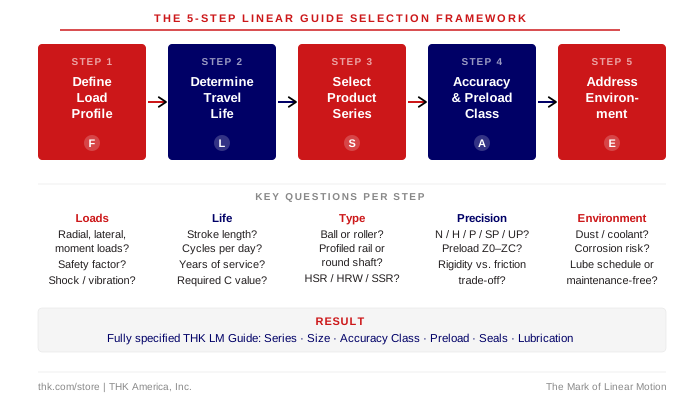
Figure 1 — The THK 5-Step Linear Guide Selection Framework
1. What Is a Linear Guide?
A linear guide — also referred to as an LM Guide (Linear Motion Guide) — is a bearing system that enables precise, low-friction linear motion along a fixed rail. Unlike conventional slides or bushings, THK LM Guides use recirculating rolling elements (balls or rollers) between a profiled rail and one or more carriage blocks. This design delivers superior accuracy, rigidity, and load-bearing capability in all directions simultaneously.
THK invented the LM Guide in 1972, and today its product line spans dozens of series — from miniature guides for medical devices to heavy-duty roller guides for multi-ton machine tools. Choosing the right series from this portfolio is the key engineering decision this guide will help you make.
Why selection matters
Using an undersized guide shortens service life and risks catastrophic failure. Oversizing adds unnecessary cost, weight, and footprint. The right guide, correctly specified, can last billions of cycles with minimal maintenance.
2. The 5-Step Selection Framework
THK recommends working through five sequential decisions. Each step narrows the candidate field and feeds into the next.
Step 1 — Define Your Load Profile
Before selecting a product series, quantify the forces your guide must carry in each direction:
- Radial load (Fr): force perpendicular to the rail, pushing down on the carriage
- Reverse radial load: upward force on the carriage (lifting load)
- Lateral load (Fs): horizontal force parallel to the mounting surface
- Moment loads: pitch (My), yaw (Mz), and roll (Mx) moments about the carriage center
Sum all loads at worst-case conditions, then apply a safety factor of 1.5 to 3.0 depending on shock and vibration levels. The resulting design load must fall below the static rated load (C0) for the chosen block size.
Tip: Moment Load Matters
Many applications underestimate moment loads. A long cantilevered table or off-center workpiece creates significant Mx or My that can dramatically reduce effective life. Always calculate moments separately from radial loads.
Step 2 — Determine Required Travel Life
LM Guide life is expressed as total travel distance (km) at which 90% of a batch would survive without flaking (L10 life). Calculate required life from your application's duty cycle:
With the required life and design load known, solve for the required dynamic rated load C:
Where P = equivalent dynamic load and C = dynamic rated load. Choose a block whose rated C meets or exceeds the required value. The THK Online Store and product catalog publish C and C0 values for each size.
Step 3 — Select the Product Series
Three primary rolling-element technologies are available, each with distinct strengths:
Ball-type LM Guides (e.g., HSR, SSR, SHS)
Ball guides provide low friction, smooth quiet motion, and excellent high-speed performance. They are the most versatile choice and cover the broadest range of applications. Ball guides tolerate slight misalignment and mounting surface errors better than roller types.
Roller-type LM Guides (e.g., HRW, SRG)
Roller guides offer 2–3× higher load capacity and rigidity compared to equivalent-size ball guides — the correct choice for heavy cutting forces, large moment loads, or applications where deflection under load is critical. The tradeoff is higher friction and greater sensitivity to mounting error.
Linear Bushings and Round-Rail Guides (e.g., SR series)
Round-rail systems are a cost-effective solution for lighter loads, longer unsupported spans, and applications requiring two degrees of freedom. Common in packaging, printing, and material handling.
| Model | Series Type | Key Characteristics | Typical Applications |
|---|---|---|---|
| HSR | LM Guide (Ball) | General-purpose, high rigidity | Machine tools, automation, robots |
| SSR | LM Guide (Ball) | Compact, space-saving | Medical devices, electronics assembly |
| SHS | LM Guide (Ball) | Highest rigidity, 4-direction load | Precision machining centers |
| HRW | LM Guide (Roller) | Ultra-high rigidity, heavy load | Heavy-duty machine tools, presses |
| SRG | LM Guide (Roller) | High accuracy, roller type | Grinding machines, high-accuracy stages |
| RSR | LM Guide (Miniature) | Miniature ball slide | OA equipment, measuring instruments |
| GLM | LM Guide (Curved) | Curved / arc travel | Transfer machines, curved paths |
| SR (Ball) | Linear Bush | Round shaft, low cost | Packaging, printing, conveyors |
| LF (Roller) | Linear Roller Bearing | Flat cage, thin profile | Semiconductor, flat panel displays |
Step 4 — Choose Accuracy Class and Preload
Accuracy Classes
| Accuracy Class | Code | Running Parallelism | Typical Application |
|---|---|---|---|
| Normal | N | ±0.04 mm | General conveyors, packaging, handling |
| High | H | ±0.02 mm | Standard CNC, assembly, robotics |
| Precise | P | ±0.01 mm | Precision machining, measuring stages |
| Super Precise | SP | ±0.005 mm | Semiconductor, optical, inspection |
| Ultra Precise | UP | ±0.003 mm | Sub-micron stages, metrology systems |
Preload Classes
| Class | Preload % | Clearance | Best For |
|---|---|---|---|
| Light (Z0) | 0% | C0 clearance | General use, long travel, cost-sensitive |
| Medium (ZA) | 2–3% of Ca | Zero clearance | Standard precision automation |
| Medium (ZB) | 5–6% of Ca | Light preload | Higher rigidity, moderate accuracy |
| Heavy (ZC) | 8–10% of Ca | Medium preload | High rigidity, precision machining |
Accuracy + Preload Rule of Thumb
For most automation and general CNC applications, High accuracy (H) + Medium preload (ZA or ZB) is the appropriate starting point. Reserve SP/UP grades and ZC preload for semiconductor, optics, or metrology equipment where the additional cost and friction trade-off is justified.
Step 5 — Address Environment, Sealing, and Lubrication
Sealing Options
- Standard end seals: included on all blocks; basic protection against dust and debris
- Side seals: added along the rail sides; recommended in moderate contamination environments
- Metal scraper seals: for heavy swarf, cutting chips, or coarse particles (machine tools)
- Full-length bellows / telescoping steel covers: for severe chip and coolant exposure
Corrosion and Special Environments
- Stainless steel LM Guide series: food processing, pharmaceutical, wash-down environments
- Ceramic balls: ultra-clean environments, semiconductor fab, vacuum chambers
- Vacuum-grade guides: special seals, lubricants, and materials for sub-atmosphere operation
- High-temperature variants: environments up to 120°C or beyond with appropriate lubricant
Lubrication
- Grease lubrication: standard; NLGI 2 EP grease unless operating temps or speeds dictate otherwise
- Oil lubrication: preferred for high-speed applications and centralized lube systems
- THK QZ Lubrication Unit: self-lubricating block insert; extends re-lubrication intervals to 20,000 km or more
- Solid lubrication: maintenance-free; for clean environments where lubricant contamination must be avoided
3. Selection Factors at a Glance
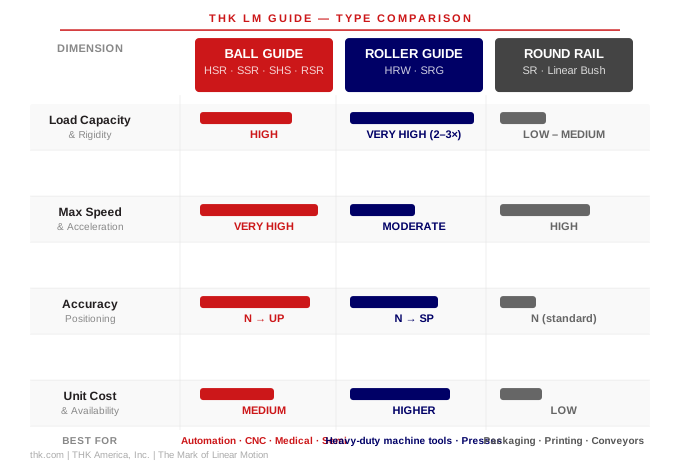
Figure 2 — THK LM Guide type comparison: ball, roller, and round-rail characteristics
| Selection Factor | Range / Options | Key Parameter | What to Determine |
|---|---|---|---|
| Load Capacity | Light to Heavy | Radial, Thrust, Moment | Required stroke × safety factor |
| Speed / Acceleration | Low to Very High | Dynamic load rating | V-max & acceleration profile |
| Accuracy / Rigidity | Standard to Ultra-High | Preload class, clearance | Positioning resolution needed |
| Travel Life | Application Cycles | L10 life calculation | Maintenance intervals, MTBF |
| Environment | Clean to Contaminated | Seals, wipers, coating | Dust, coolant, wash-down, vacuum |
| Mounting Geometry | Horizontal / Vertical | Block type, flange options | Space envelope & rail length |
| Operating Temp. | -20°C to +80°C typical | Lubricant type, material | Thermal expansion compensation |
| Lubrication | Grease or Oil | QZ lubrication unit option | Maintenance-free vs. scheduled |
4. Selection Examples by Application Type
Use these common configurations as a starting point for your own application engineering.
Machine Tool (Milling Center)
- Series: HRW (roller) or SHS (ball)
- Accuracy: Precise (P) or Super Precise (SP)
- Preload: ZB or ZC
- Sealing: Metal scraper + full-length cover
- Lubrication: Centralized oil or high-load grease + QZ
High-Speed Pick-and-Place
- Series: SSR or HSR (ball, compact)
- Accuracy: High (H)
- Preload: ZA
- Sealing: Standard end seals
- Lubrication: Light grease or QZ unit
Semiconductor Wafer Stage
- Series: SHS or SRG (vacuum-compatible)
- Accuracy: Ultra Precise (UP)
- Preload: ZB or ZC
- Sealing: No contact seals; positive pressure enclosure
- Lubrication: Solid lubricant or vacuum-grade oil
Medical Imaging Gantry
- Series: HSR or SSR stainless variant
- Accuracy: High (H) or Precise (P)
- Preload: ZA or ZB
- Sealing: Stainless end seals
- Lubrication: NSF H1 food-grade grease or QZ
Conveyor / Sortation System
- Series: HSR or SR linear bush
- Accuracy: Normal (N) or High (H)
- Preload: Z0 or ZA
- Sealing: Side seals or dust wiper
- Lubrication: Standard grease or QZ unit
5. Working with THK America
THK America's engineering team is available to support your selection process from initial specification through final validation. Our applications engineers can perform life calculations, review mounting drawings, and recommend optimal configurations.
Tools and Resources
- THK Online Store (store-na.thk.com): browse, configure, and order LM Guide products with real-time availability
- THK Product Catalog: comprehensive dimensional data, load ratings, accuracy tables, and ordering codes
- THK Technical Support: +1-847-310-1111
- CAD Downloads: 2D/3D models available for all standard products via the THK Online Store
Ordering Code Structure
THK model numbers encode the series, size, accuracy class, preload, and options in a structured string:
Ready to specify your linear guide?
Browse the full THK LM Guide portfolio with real-time pricing and availability.